
Core Beliefs
God
We believe Yahweh is the one true God, creator of heaven and earth, manifest in three persons: Father, Son, and Holy Spirit (Jn 1:14, 17:21-24; 1 Cor 8-6; 1 Jn 5:7, 8).
Yeshua
We believe Yeshua was crucified, buried, and resurrected from the dead on the third day. Yeshua is the final mediator between God and all humanity (1 Tim 2:5, 6; Heb 9:15). Forty days after His resurrection, Yeshua ascended into heaven and will, one day, physically return (Acts 1:11).
Scripture
We believe the Bible (sixty-six books of the Jewish-Christian Bible, in the original manuscripts) are the inspired and infallible word of Yahweh. The Bible is the final authority in establishing all doctrinal truths, all principles for living, and all practices of worship (Ps 119:105, 130; 2 Tim 3:16, 17).
Virgin Birth
We believe Yeshua was conceived by the Holy Spirit, of a virgin (Miriam), and born a man (Mt 1:18-25; Lk 1:26-38).
Judgment
We believe Yeshua judges the living and the dead (Jn 5:21-30; Acts 10:42; 2 Tim 4:1; 1 Pet 4:5).
Sin
We believe every person has sinned and fallen short of God’s glory. Thus, all are in need of the justification offered to us by Yahweh, through Yeshua: a justification that releases us from the penalty of sin and affords us right standing with God (Rom 3:23; Gal 3:22).
Repentance
We believe repentance is necessary for forgiveness and attaining right standing with Yahweh. Forgiveness is possible only through the shedding of Yeshua’s innocent blood (Mk 2:17; Acts 11:18; Rom 2:4; 2 Pet 3:9; 2 Cor 7:9-10; Col 1:13, 14).
Grace & Works
We believe one’s salvation (i.e., justification) is by grace through faith, not of works (Eph 2:8-13; 2 Tim 1:8, 9). Nevertheless, we were created for good works; that is, to walk in the commandments of our God (Eph 2:10).
Important Understandings
On Rites
The essential rites include the Lord’s Table (communion), water baptism, and the laying on of hands (1 Cor 10:16, 17; Heb 6:1-3).
Indwelling Spirit
The Holy Spirit (Ruach HaKodesh), whom the Father has sent in Yeshua’s name, dwells within all believers for the purpose of leading, guiding, teaching, comforting, and empowering them to live righteous lives (Heb 13:8; Jn 14:26).
Role of Torah
Yeshua did not come to abolish the Law (Torah), but to show people how to properly live the Torah while in a right relationship with the Father. All Scripture (i.e., the Tanakh at the time of Paul’s letter to Timothy) is given by inspiration and is profitable for doctrine, for reproof, for correction, and for instruction in righteousness so that the man (and woman) of God may be complete, thoroughly equipped for every good work (Mt 5:17; Gal 3:22-25; 2 Tim 3:16, 17).
Torah & Transformation
For the unbeliever, the Law is a “ministry of death” (2 Cor 3:7), designed to show people their sin and, consequently, their need for forgiveness. For the believer, however, while the Law still points out sin, the primary function of the Law shifts to facilitating life (characterized by righteousness). Thus, the Torah (Genesis, Exodus, Leviticus, Numbers, Deuteronomy) contains the “law of liberty” (Jas 1:25) and was graciously given to us, by Yahweh, as a standard for righteous living.
Given these truths, the Law has two primary functions. First, the Law points us to salvation. Second, the Law serves as a means of sanctification. Thus, Torah observance cannot save (Jn 5:40) or sanctify (Ex 31:13). Post-salvation, then, those who love Yeshua, having received the Spirit (Ruach) for the transformation of their “inner man” will walk in Yahweh’s commandments (Jn 14:15) and, in doing so, will walk as ones set apart and blessed (Lev 20:7, 8; Dt 28:1-14; Jn 14:20-23, 15:1-10; Rom 12:1, 2; 1 Pet 1:16; 1 Jn 5:2, 3).
Given these truths, the Law has two primary functions. First, the Law points us to salvation. Second, the Law serves as a means of sanctification. Thus, Torah observance cannot save (Jn 5:40) or sanctify (Ex 31:13). Post-salvation, then, those who love Yeshua, having received the Spirit (Ruach) for the transformation of their “inner man” will walk in Yahweh’s commandments (Jn 14:15) and, in doing so, will walk as ones set apart and blessed (Lev 20:7, 8; Dt 28:1-14; Jn 14:20-23, 15:1-10; Rom 12:1, 2; 1 Pet 1:16; 1 Jn 5:2, 3).
Local Assembly
All who trust in Yeshua, each in their generation, are to live out their faith in the context of a local community of fellow believers (Heb 10:25).
Grafting
When a Jew or Gentile (non-Jew) places their trust in Yeshua as Messiah, they are grafted (or re-grafted), by faith, into the “olive tree” of Israel. Faith in Israel’s Messiah Yeshua makes one a member of the commonwealth of Israel. Our (ancestral) father, Abraham, believed God and it was credited to him as righteousness. In the same way, those who’ve trusted in Messiah for the forgiveness of sin are in Abraham’s seed (Yeshua) and heirs according to the Promise (Jn 8:33-39; Rom 11:17-27; Eph 2:11-19; Gal 3:29).
One Law
There is not one law for the Jews and another for Gentiles. Rather, there is one King (Yeshua), over one people, who walk together in one law (Ex 12:49).
Biblical Interpretation
Understanding the culture, contexts, history, language, idioms, and the authors of Scripture is necessary to understanding the Bible. Scripture cannot be broken (Jn 10:35) and thus the original meaning of Scripture stands firm and cannot be overturned by the contextual interpretations of men.
Apocryphal Texts
Yeshua’s House acknowledges the existence of apocryphal and pseudopigraphal texts. During the Second Temple Period, the majority of the Jewish community, including followers of Yeshua, did not view these works as Nivru (inspired). Additionally, the textual preservation of these writings often lacks the consistency and manuscript reliability found in the established Tanakh (OT) and Apostolic Scriptures (NT). While we value these writings for their historical, linguistic, and cultural insights into the world of the Bible, YH does not consider such texts divinely inspired. Therefore, while these texts may serve as supplemental resources for context and insight, YH does not feel it prudent to use such texts to establish doctrine or liturgy.
Weekly Sabbath
As the people of God, we keep the seventh day holy; inasmuch as it’s in our control, we neither do any regular work, buy, or sell. We gather as the people of God, in a holy assembly, for the purpose of studying Yahweh’s revealed Word and worship (Ex 20:8-10).
Appointed Times (Moedim)
We observe the annual feasts of the Lord (Lev 23). These feasts are annual celebrations or solemn observances that cause us to remember important aspects of salvific history or prepare for the future return of Messiah Yeshua and everlasting Kingdom. All of Yahweh’s appointed times exalt the person and ministry of Yeshua (Acts 2:1, 12:3-4, 27:9).
Restoration of Israel
The restoration of the two kingdoms of Israel (scattered northern tribes and the southern tribes of Judah, Simeon, and Benjamin) will once again, upon Yeshua’s return, be joined together in the land of Israel and Yeshua will rule over the one nation (Lev 26:40, 42-45; Jer 33:25-26; Ez 36:21:22).
Name of God
While knowing and using the proper name for God (Father and Son) is, in principle a matter of some significance, we currently recognize a lack of sufficient and hard evidence for the exact pronunciation either YHWH (i.e., Yahweh or Jehovah) or the spelling and/or the pronunciation of Yeshua (Y’shua, Yeshuah, Yehoshua, Jesus). Without a strong scholarly consensus on such matters, we believe tolerance for variations in convictions regarding the name of God is the proper and godly response. Individuals who are or intend to be divisive on this issue are not welcome.
Promises of God
As a community, we believe Yahweh keeps all of His unconditional promises whether to individuals, the nation of Israel, or to believers in the Body of Messiah (Acts 2:39; Gal 3:14; Eph 1:13; Heb 9:15, 1 Jn 2:25).
Marriage & Family
The family is the basic unit of the community of faith, founded through the uniting of one man and one woman in holy matrimony. From the beginning (Adam and Eve), marriage is depicted and described as one man in covenantal relationship to one woman. This Biblical depiction and description is confirmed by Yeshua and His Bride. The family unit is the basis of Biblical nurture. Parents are to disciple their children, diligently teaching them, in word and deed, Yahweh’s commandments, statutes, and judgments (Gen 2:24; 2 Cor 11:2; Eph 5:31-33; Eph 6:4; Dt 6:7; Mal 4:4-6).
Resurrection of All
Both the saved and unsaved are resurrected: the saved to everlasting life and the unsaved unto eternal separation from God. Without Yeshua, sinful man is lost and must be born again by the Holy Spirit (Ruach HaKodesh) to enter the Kingdom of heaven (Jn 5:28, 29; Rev 20:5, 6, Jn 3:3-7; 1 Cor 12:4-13).
Elders & Teachers
In Yahweh's economy, men and women are equal but different. And while we understand the roles of men and women in the context of believers' fellowship and households are a sensitive topic, YH holds that men are to take the lead, as Yeshua did, in matters of spiritual leadership and sacrifice. Practically, this means only men may formally serve as elders (1 Tim 3:1-7). Further, only men may teach during times of ritual authority (e.g., a sabbath or appointed time). May women lead and teach? Yes. In fact, we encourage it. At the same time, we ask that women, in humility, not place themselves in authority over men (1 Tim 2:12). And to men we ask, in humility, that if a woman has sounder judgment on a matter, that you yield to her wisdom as Yahweh has created her to love, help, and fight for you. Truly, we are better together.
Our Elders
Our Elders meet twice a month for fellowship, prayer, and leading YH. As we govern, a few guiding principles inform our decisions. First, what does the Bible say? Second, what's best for our fellowship? Third, what do our wives and trusted advisors think about the harder matters? In other words, we don't lead in a vacuum or from atop a tower. Instead, we endeavor to lead as our Master led; we seek the Father first in all matters and govern from a position of humility, service, and sacrifice. And if we may ask, please let us do our Yahweh-mandated jobs; YH operates best when the authority structure is honored.
We should note, too, that on occasion the Elders may add statements to our "Important Understandings" section. Though we don't anticipate adding statements often, we will do so should the need arise for clarify and foster shalom.
We should note, too, that on occasion the Elders may add statements to our "Important Understandings" section. Though we don't anticipate adding statements often, we will do so should the need arise for clarify and foster shalom.
Important docs coming soon.
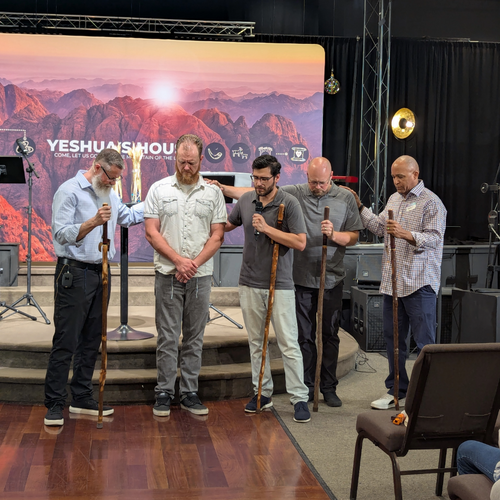
Our Elders (L-R): Traver Dougherty, Jacob Kelsch, Humberto Dueñas, Matt Anderson, Victor Spencer.